
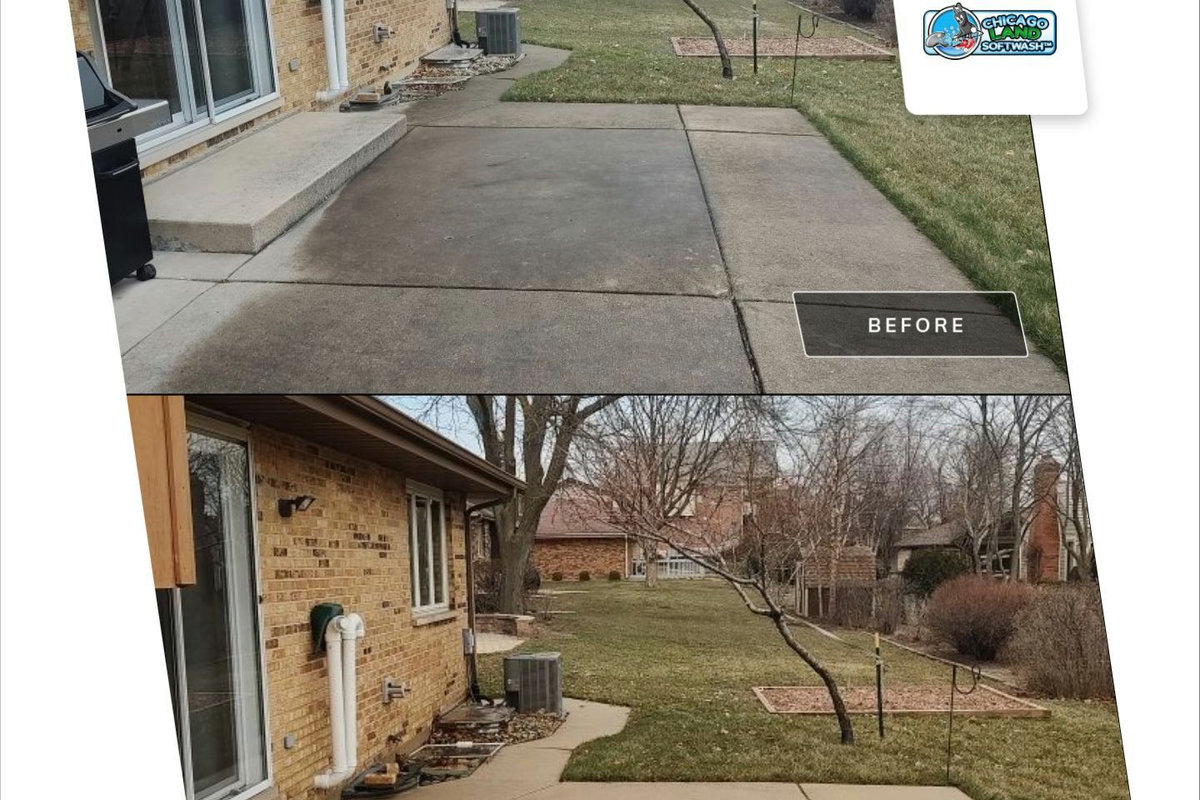
Fresh concrete is almost white. Go look at the newest driveway on your block. If yours is gray or blotchy black, that's not age. It's a film sitting on the surface, and it comes off.
The film has three layers
The same algae from the roof post lives down here too, packed into the pores where the hose can't reach. On top of that: tire film ground in every time you pull in, and a season's worth of winter salt residue. Chicagoland freeze-thaw makes it worse. Every cycle pulls grime a little deeper into the pores.
Why the rental washer leaves zebra stripes
A pressure wand is a hand tool, and hands are uneven. Every pass is a slightly different height, angle, and overlap, so the driveway dries with stripes burned across it. A wand held too close doesn't just clean concrete, it etches it. Worse, pressure alone only moves the growth around. Same lesson as the roofs: if it's alive, the fix is chemistry first.
What a surface cleaner does differently
It's the machine our mascot rides: spinning jets under a hood, locked at one height, so every square inch gets the identical pass. No stripes, no etching. We pre-treat so the biology dies at the root, run the surface cleaner, then post-treat so the white holds and the growth comes back slower. Works on driveways, sidewalks, patios, and pavers.
Do it before the salt goes down
Salt sits in dirty pores all winter and helps the surface flake. That's the pitting you see on older driveways. A wash in late summer or fall means the salt lands on clean, tight concrete instead. That's the cheap version of driveway repair: not needing it.
Wondering if yours would come back white? Snap a photo of the worst patch and send it with a free estimate request. A photo gets you a tighter quote, faster.